Tech
shomi Now Available in Beta Trial for Rogers and Shaw Customers #readysetshomi
 shomi, the new video streaming service in Canada, was launched last Tuesday, November 4, 2014. It is available in beta trial first to Rogers and Shaw Internet or TV customers. Eligible Rogers customers can sign-up for a 30-day trial, after which will be $8.99 per month. If you only want to test it out, make sure to cancel at anytime before the 30 days are up.
Past seasons of current hit TV shows which are not available on any other streaming service (like Netflix) are available on shomi such as 2 Broke Girls, Revenge, New Girl (a few of the shows I watch). Other shows include American Horror Story, The Blacklist, Modern Family, The Originals, Rookie Blue, Sleepy Hollow, Shameless, Sons of Anarchy, and Vikings. 30% of the content will be Canadian content (both TV shows and movies). If you’re not sure what to watch, shomi has trailers, Rotten Tomatoes ratings, and factoids to help you in deciding what to watch.
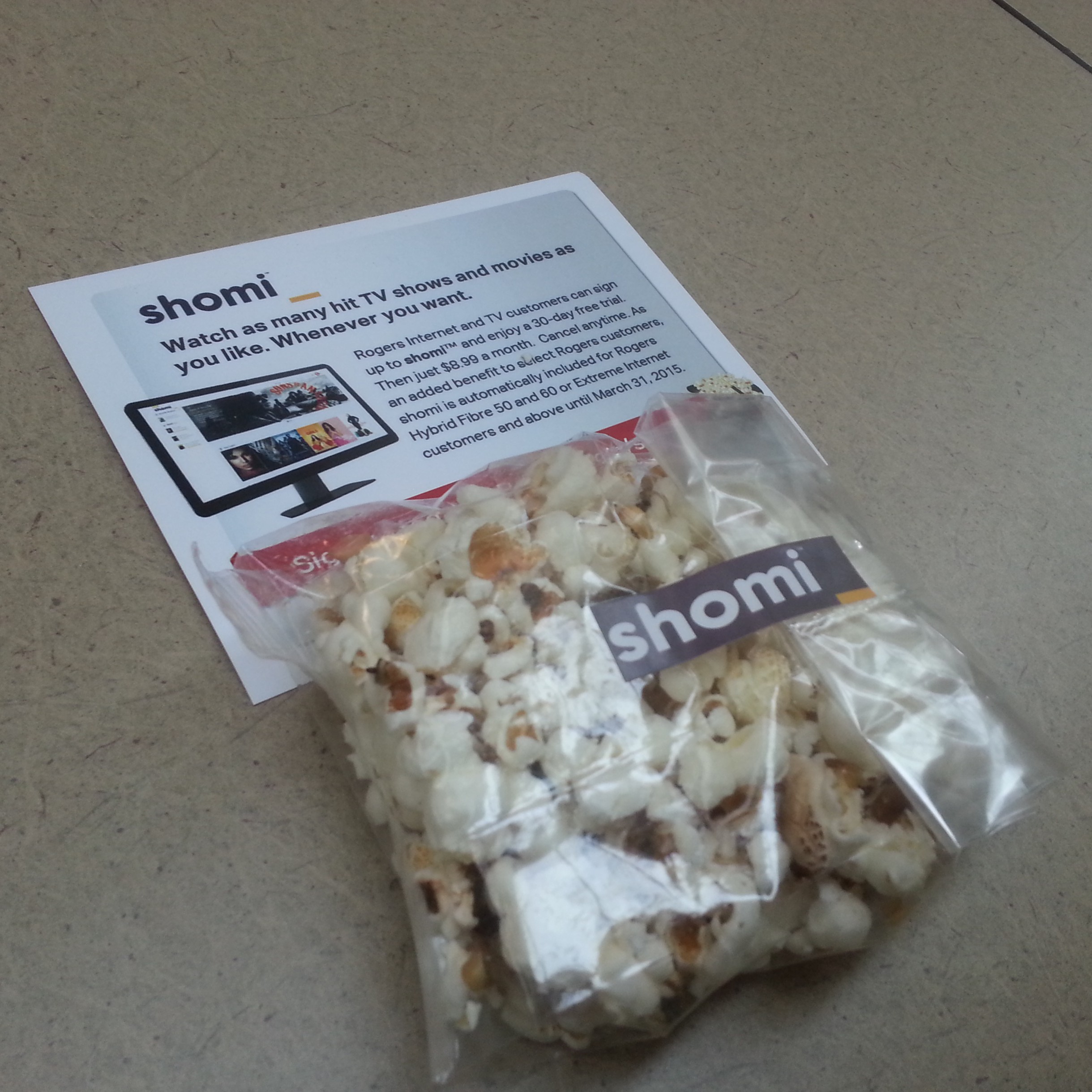 So some may ask, what’s the difference between shomi and content on Rogers On Demand (ROD) or Rogers Anyplace TV (RAPTV)? ROD and RAPTV have access to multiple seasons of shows, as well as the currently-aired season, and newly-released movies the same day they are released on DVD. To access these however, customers must be subscribed to those channels airing those shows within their cable TV package, or pay on a per movie basis (for movie rentals). On the other hand, subscribers to shomi will have access to all video content available within shomi. shomi is complementary to the digital TV, ROD, and RAPTV services, not a complete replacement.
If you want to watch/subscribe to shomi on your Rogers set-top-box, it is available on channel 300 everywhere it’s offered, as well as on NextBox channel 100 in Ontario.
For more information on shomi, check out shomi.rogers.com or shaw.ca/shomi.
Related Articles:
Popcorn and Magic, Art and Science…its Showtime! [Rogers Redboard]
“shomi” the new way to watch TV for Canadians
Disclosure: I work for Rogers, however, all the opinions on this site are my own and do not in any way reflect my employer’s.
New Features for BBM Include Timed Messages and Message Retraction for More Privacy and Control
 BlackBerry released new features for BlackBerry Messenger (BBM) on Friday, October 31, 2014 which include Timed Messages and Message Retraction. This allows users to have more privacy and control over their messages.
With “Timed Messages”, similar to popular photo messaging app Snapchat, you can set a timer to control how long messages and pictures you share can be viewed within BBM. The message is hidden until the recipient touches and holds on the chat. Once the timer expires or if the recipient takes their finger off the screen, the message is no longer visible. The user also receives a notification if BBM detects that the recipient has taken a screenshot of the image or message. Only thing is, if the recipient has another phone/camera handy, of course they could still take a picture of the picture/message without you knowing it.
With “Message Retraction”, users can now retract messages from their BBM chat before it will be read by the recipient, or even after it has been read so that it will no longer be visible within BBM.
The premium features will be available to BBM users for free for the next three months, after which will be offered as part of a broader bundle of features with a BBM subscription.
Other new features include a quicker sticker picker, HD Picture Transfer, and the ability to see what music your contacts are listening to in BBM Feeds.
Check out this video showing how the new features can be useful:
Phones That Are Confirmed to Get the Android Lollipop Software Update

Android Lollipop, the Android software version 5.0 formerly simply known as Android “L”, has been reported to have a November 3, 2014 release date. No official date has been announced yet by Google however.
The features included in the update include the following:
- A bold, colorful, and responsive UI design for consistent, intuitive experiences across all your devices
- New ways to control when and how you receive messages – only get interrupted when you want to be
- A battery saver feature which extends device use by up to 90 mins
- Use Android Smart Lock to secure your phone or tablet by pairing it with a trusted device like your wearable or even your car
- Multiple users for phones. If you forget your phone, you still can call any of your friends (or access any of your messages, photos etc.) by simply logging into another Android phone running Lollipop.
- Guest user for phones and tablets means you can lend your device and not your stuff
- New handy controls like flashlight, hotspot, screen rotation and cast screen controls
- Improved network handoffs resulting in limited interruption in connectivity. For example, continue your video chat or VoIP calls without interruption as you leave the house and switch from your home Wi-Fi back to cellular
- Even if your screen is off, you can say “OK Google” on devices with digital signal processing support such as Nexus 6 and Nexus 9
The above are just a few of the features available on the latest upcoming update. Keep in mind that not all Android devices will get the software update at the same time. Here is a list of what phones have been confirmed (or almost confirmed) to get the update:
- Google Nexus 6 will come with Android 5.0 already installed.
- Nexus 5
- Nexus 4
HTC
- HTC One M8
- HTC One M7
- Both phones will get the upgrade within 90 days of the software’s final release.
LG
- LG G3 will get the update before the end of the year (not completely confirmed)
- LG G2 will get the update in early 2015 (not completely confirmed)
Motorola
- Moto X
- Moto G
- Moto G LTE
- Moto E
- Droid Ultra
- Droid Maxx
- Droid Mini
Samsung
- Galaxy S5 will get the update by December 2014 (not completely confirmed)
- Galaxy Note 4
- Galaxy S4
- Galaxy Note 3
- Above Samsung phones not completely confirmed at this time.
References:
“Android 5.0, Lollipop”. Android.com. Retrieved October 26, 2014.
Eadicicco, Lisa (October 26, 2014). “Here Are All The Phones Confirmed To Get Google’s Massive Android Update”. Business Insider. Retrieved October 26, 2014.
Your Options for High Speed Internet Service in the Greater Toronto Area, Canada
DSL, Cable, or Fibre Optic internet access are the different broadband high speed internet options available for anyone these days, most especially in major urban cities around the world. For this blog post, I will be writing about what options are available for consumers in the Greater Toronto Area (GTA) in Ontario, Canada.
First off, let’s differentiate DSL, Cable and Fibre internet:
DSL (Digital Subscriber Line)
A Digital Subscriber Line or DSL connection, uses the existing copper wire of your phone line to deliver high speed internet access. While not as fast as cable, this type of connection is incredibly faster than dial-up and suits the needs of most home users just fine. On top of being suitably fast, this type of connection also tends to be notably less expensive than cable, which is the main reason it has became such a popular option so quickly. One critical factor that will impact your decision on DSL is the distance between your home or office residence and the provider’s central office. The further you are from the main line, the weaker the signal, and the slower the connection. With that being said, DSL is not as widely available as cable so you will need to inquire with your local phone company regarding availability. (FiberforAll.org)
Cable
Though often confused with fibre, cable utilizes the coaxial cable that connects to your television set. In contrast to DSL, the quality of a cable connection does not depend on distance so your speed is guaranteed regardless. However, unlike DSL, which runs on a dedicated line, cable connections are typically shared amongst your neighbors, making it a slightly less secure option. As far as speed goes, cable access ranges from about 3 to 10 Mbps, which is essentially 3 to 4 times faster than DSL. Keeping in mind that this speed is reflected in the price, you should expect to pay a lot more for cable service. (FiberforAll.org)
Fibre
Fibre optic offers many advantages over conventional copper cable lines. It is able to transmit data much faster over greater distances and because the cable is smaller in diameter and weighs less, it makes an ideal alternative for a wide variety of cabling solutions. Since the conductor is glass and cannot generate electricity, fiber is immune to all sorts of interference. This means that it can come in direct contact with high-voltage electrical equipment, power lines and lightning, all while still putting out a superior performance. Because fibre optic cables cost less to maintain, the price for service tends to be much less than cable and very competitive with DSL. The major downside to fibre is that service is only available in a few markets, so there is no guarantee that you will be able to find it. (FiberforAll.org)
Now that we’ve differentiated the three high speed internet options, let me list the various Internet Services Providers (ISPs) available in the GTA for residential customers:
- Acanac
- Bell
- Beanfield Metroconnect
- CIK Telecom
- Comwave
- Distributel
- ElectronicBox
- Execulink
- Innsys
- Primus
- Rogers
- Start Communications
- SwitchWorks
- TekSavvy
- Telnet Communications
- Toronto Free-Net
- TorontoHighSpeedInternet.ca
- VMedia
- Worldline
- Yak
- ZiD Internet
 Most of the ISPs on the above list are Third-Party Internet Access (TPIA) providers, meaning they are wholesale high-speed access (WHSA) resellers of the large major carriers such as Rogers, Bell, Cogeco, Shaw, who offer their own retail internet services to their own end-users. Several of these TPIA providers tend to offer cheaper rates than those of the major providers.
The above list only includes those that offer internet services to residential customers, but most of these ISPs also offer internet services to businesses. Take note that there are other available ISPs in the GTA, however they only cater to businesses, not residential.
Whether DSL, Cable, or Fibre, GTA residents have a lot of options to choose from for their internet service. The differentiating factors in making the decision to go with a certain ISP are pricing, speed, and customer support. Most of the internet speeds offered by the various ISPs are similar. However, advertised speeds are not always the same as actual speeds. I will be writing more on that in a future blog post, so stay tuned!
Who is your internet service provider and are you satisfied with them? Let me know in the comments below.
Photo Credit: Kristina Alexanderson
Bloomberg Game Changers
 One weekend a couple of months ago or so, my S.O. and I were looking for something to watch on Netflix and he found this documentary series called Bloomberg Game Changers. The series produced by Bloomberg TV features different business leaders and successful entrepreneurs who “climbed to the top and changed our world” in one way or another. There were a few there that really piqued my interest, namely:
- Apple Founder and former CEO Steve Jobs
- Google Co-Founders Sergey Brin and Larry Page
- Facebook Founder and CEO Mark Zuckerberg
- Amazon.com Founder and CEO Jeff Bezos
- American Vogue Editor-in-Chief Anna Wintour
- Twitter Co-Founders Evan Williams, Noah Glass, Jack Dorsey, Biz Stone
The list above is hyperlinked to the series videos found on the Bloomberg TV website which I highly recommend to watch. The last one on my list above was actually not available at that time on Netflix and I had just watched it while writing this blog post.
It’s pretty cool learning about these people’s lives as told by their peers and colleagues leading up to the success in whatever they had created. Without these people, the world would definitely be significantly different than what it is today. All of them have contributed to making the world and its people more connected in some way. I think that’s something to be thankful for. (Happy Thanksgiving, Canada!)
 Tech-Life in Pink